Blog: “Co producing an online autism peer support group”
Over the past year, the Devon Mental Health Alliance have offered a monthly online group for autistic adults co-produced and facilitated by someone with lived experience of autism, and someone who is familiar with the assessment and diagnosis process. Trish Osborn, co-facilitator of the Devon Autism Peer Support Online (DAPSO) group, has written her own reflection on how the group has grown since the beginning. We are delighted to have a first-hand account of how DAPSO was produced and the journey it has taken from idea to a flourishing online community.
Trish writes; “Like answering questions on “Who wants to be a Millionaire” facilitating a group seems easier when someone else is doing it. This blog is offered to share the experience of co producing and running an online group, and what was learnt along the way.
In the beginning was the need. The need for autistic people to be able to talk about “all things autistic” in a safe space. Feedback from autistic adults in Devon indicated they felt isolated before, during and after diagnosis. We wanted to provide a safe online space for autistic people to meet and talk.
Devon Mental Health Alliance was the catalyst which enabled the group to happen. Specific names will not be mentioned, but the DMHA workers, who went over and above to make the idea of an online autism peer support group a reality, will hopefully recognise themselves.
DMHA were passionate about getting the group going. And up for lived experience to be embedded in developing ideas from the very start. An email to the higher ups at DMHA in March 2025 got a speedy response, with a teams meeting set up for April. This meeting focused on how an online group could work, what was needed, whether the potential co facilitators had the knowledge and skills to run the group, and whether DMHA had the expertise and resources in place to support the launch and rollout of an autism peer support group.
Yes! DMHA could provide an email account and access to teams meetings. On their website they had a well established calendar to publicise meetings, and their Facebook account had followers.
Crucially, they were able to provide funding for facilitator time, and a new manager in post had experience and capacity to provide line management and supervision. The comprehensive DMHA training and support package in place for workers could be made available to two more. Robust protocols managing safeguarding issue were already established, and there was honest acknowledgement that safeguarding concerns can present particular challenges in online groups.
If this sounds too good to be true, it wasn’t. There were lots of “moments” along the way when courage and persistence, and a sense of humour were needed to keep going.
The April Teams meeting established that two facilitators were needed, and their role would include welcoming people, establishing ground rules, and building up trust so people felt safe sharing ideas and experiences.
The timescale between conception and birth of the group was like a speeded up pregnancy. The first email to DMHA was sent in March and the first group meeting was held in June. An awful lot happened in between, fuelled by enthusiasm and goodwill, alongside panic over the tech aspects of an online group.
Technology presented most of the initial problems. We composed a carefully formatted autoreply for the email account, but were dispirited to find that the text all ran together, making it difficult to read. The DMHA Co Production Steering Group were roped in to comment on the content, and test that the autoreply was easy to read - connecting in with these experts by experience was invaluable.
Mental health provision needs a pick and mix approach to meet different needs. Working on the sweet counter at Woolworths, I noticed one person would choose soothing chocolate, another salty liquorice, and another would very slowly select an assortment of toffees, seeking conversation and connection as much as the sweets. In a similar way, people come to the group with different needs, some have a definite question to ask, or a particular experience they want to share, others because they want to meet other autistic people or learn more about autism. Either way It is almost certainly the conversation and connection with peers which brings them back.
For people that don’t return, the hope is that they have had an answer to their question, have felt heard, or have found something else, maybe signposted or talked about in the group, which suits them better.
Members have fed back that they appreciate being in an online space where others share thoughts and feelings about their autism journey. The session is not a place to focus deeply on the situation of any one member, or offer psychotherapeutic insights. It is a peer support group, not a therapy group.
There have been times where someone starkly described a traumatic situation in distressing detail. Co facilitators needed to acknowledge the distress as valid, whilst aware that the content could be triggering for others. This is challenging - and needs facilitators to work in partnership; e.g. one facilitator is able to respond compassionately to the person describing their trauma, followed by input from the other facilitator to carefully move the conversation on.
An opportunity to stay on to talk with Co facilitators after the meeting has ended is offered, for anyone that has a specific question, or who feels the need for a debrief. This is definitely needed in an online group, as there isn’t an opportunity to have a private face to face moment with co facilitators during the meeting.
The group had a soft launch - quietly being included on the DMHA website online meetings calendar and Facebook pages. Members tended to hear about the group by word of mouth from peers or from mental health professionals. By January 2026 we were ready to market the group more widely; hard copies of leaflets were printed, and Instagram and social media posts stepped up. Again, the infrastructure of DMHA and co operation of their admin staff was vital.
We collected quantitative data on the number of people attending each meeting, and qualitative data around meeting content. This has provided a contemporaneous record for us to reflect back on and guide future plans. And has also provided a record of thanks - which we were not expecting but which we find heartwarming.
Did any meetings go badly? At the beginning, co facilitators were naturally nervous, and things didn’t always come across in a way members understood and related to. It took a while to build up skills and confidence to intervene if one member was monopolising too much time. Some members requested support which was beyond the scope of an online group. So there were some awkward moments, but feedback indicated that people attending were glad that they had come, and were in a better place when they left than when they arrived.
One key ground rule, from the beginning, was that members could switch on their cameras and contribute verbally only when they feel comfortable doing so. Comments are welcome in “the chat” and any clunkiness of reading them out was outweighed by the reflections they prompted.
Running the group has got easier and feels more natural one year on. We make and share a meeting plan with each other, but this is a prompt rather than a set of instructions. And it can be laid aside during the meeting, as long as it is used to remind us to put in a comfort break and to keep time protected for a checkout.
In retrospect, it seems that the likelihood of the group meeting people’s needs was enhanced by the non-hierarchical model of it’s development. The idea for it came from people with lived experience. And throughout Co Production with DMHA, voices of lived experience were respected as valid and equal to the voices of those in professional roles.”
Key things learnt along the way:
Two facilitators are not enough. In the case of one being unable to attend, backup is needed.
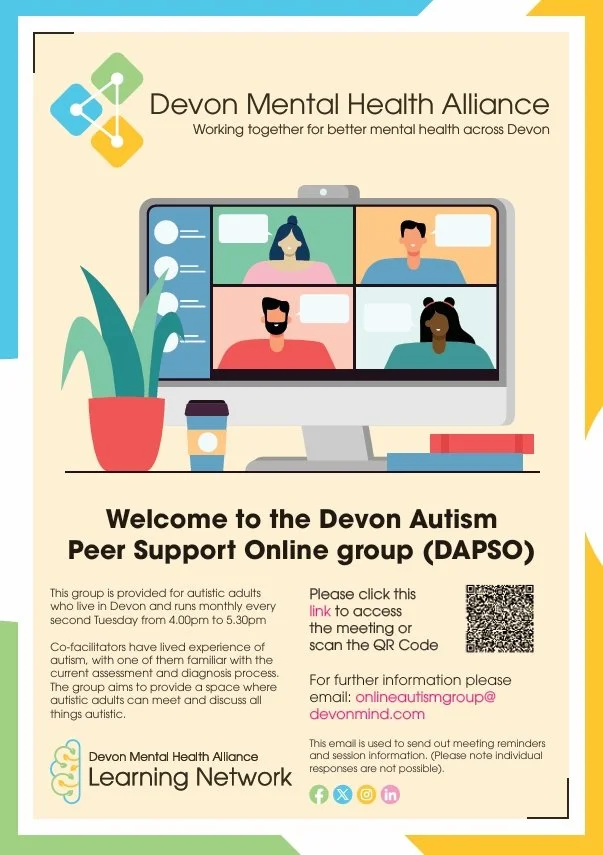
Having a QR code people can use to come in by phone is helpful (in addition to, not replacing, the teams link).
Respecting and reading out messages put in the chat including people in conversations who may otherwise go unheard.
Although it is tempting to skip the comfort break when conversation is flowing, moving around and different sensory input for a couple of minutes leads to richer engagement in the second half of the meeting.
The group is offered as a peer support group, not a therapy group.
The checkout is a vital part of the group structure.
Reviews provide a space to stop and step back, and to share concerns and successes with DMHA.
There is no definitive “right” way of running an online group - it’s a bit like building a plane as you fly it, and testing which wings fly well.
When people say thankyou, it makes all the hard work worthwhile
The Devon Mental Health Alliance would like to thank Trish for her insightful account and her contribution alongside co-facilitator JoJo. Together the pair have offered a consistent supportive space for people to connect, share stories and find common ground.
DAPSO meet online every second Tuesday of the month, the next online meeting is: Tuesday 10th November
If you, or someone you know, may be interested in joining the Devon Autism Peer Support Online community, click here to learn more: DAPSO Meeting Information